
The hiring market is quietly changing, and I don’t think enough companies fully realize what’s happening yet.
From working closely with hiring teams and candidates across multiple industries, I’ve noticed that the shift isn’t simply “AI vs AI”, where both candidates and companies use AI throughout the hiring process.
It’s much more subtle than that.
Yes, more candidates are using AI. A lot more. But the real change is not just in usage, it’s in behavior.
Candidates today don’t just polish their CV, they reverse-engineer the hiring process. They analyze job descriptions, predict keywords, and optimize their entire profile to “pass the system.”
I’ve seen candidates submit extremely strong-looking CVs that, in interviews, don’t translate into the same level of clarity, depth, or experience.
There’s a growing gap between presentation quality and actual capability.
Strong-looking CVs that don’t translate into strong interviews.
Well-structured career stories that fall apart under deeper questioning.
Candidates who know exactly how to “pass the process”, but not necessarily how to do the job.
At the same time, many companies are still hiring as if what they see on paper reflects reality. In 2026, that assumption is becoming less reliable.
The real shift: from information to validation
Hiring used to be about collecting information. Today, it’s becoming much more about validating it.
Recruiters and hiring managers are no longer just asking:
“Is this candidate relevant?”
They are asking:
“Is this real?”
This changes the role of recruiters significantly.
- Screening becomes less about reading and more about questioning
- Interviews become less about experience and more about depth
- Intuition and pattern recognition become more critical than ever
A new skill gap is emerging.
One of the most interesting things I’ve noticed:
We’re not just seeing a gap between strong and weak candidates. We’re seeing a gap between:
- Candidates who know how to work
- And candidates who know how to present themselves through AI
And those are not always the same people.
This creates a real risk for companies:
Hiring candidates who are highly skilled at navigating the hiring process itself rather than succeeding in the actual role.
What I think will actually change
Not everything will change overnight, but a few clear shifts are already starting:
- More emphasis on live interactions earlier in the process, less reliance on home tasks alone
- More skepticism from recruiters, Strong CV ≠ strong candidate anymore
- Higher value on consistency: Can the candidate tell the same story across CV, interview, and real examples?
- AI detection won’t be the solution, Process design will be
AI is not the problem. But the illusion of accuracy it creates is.
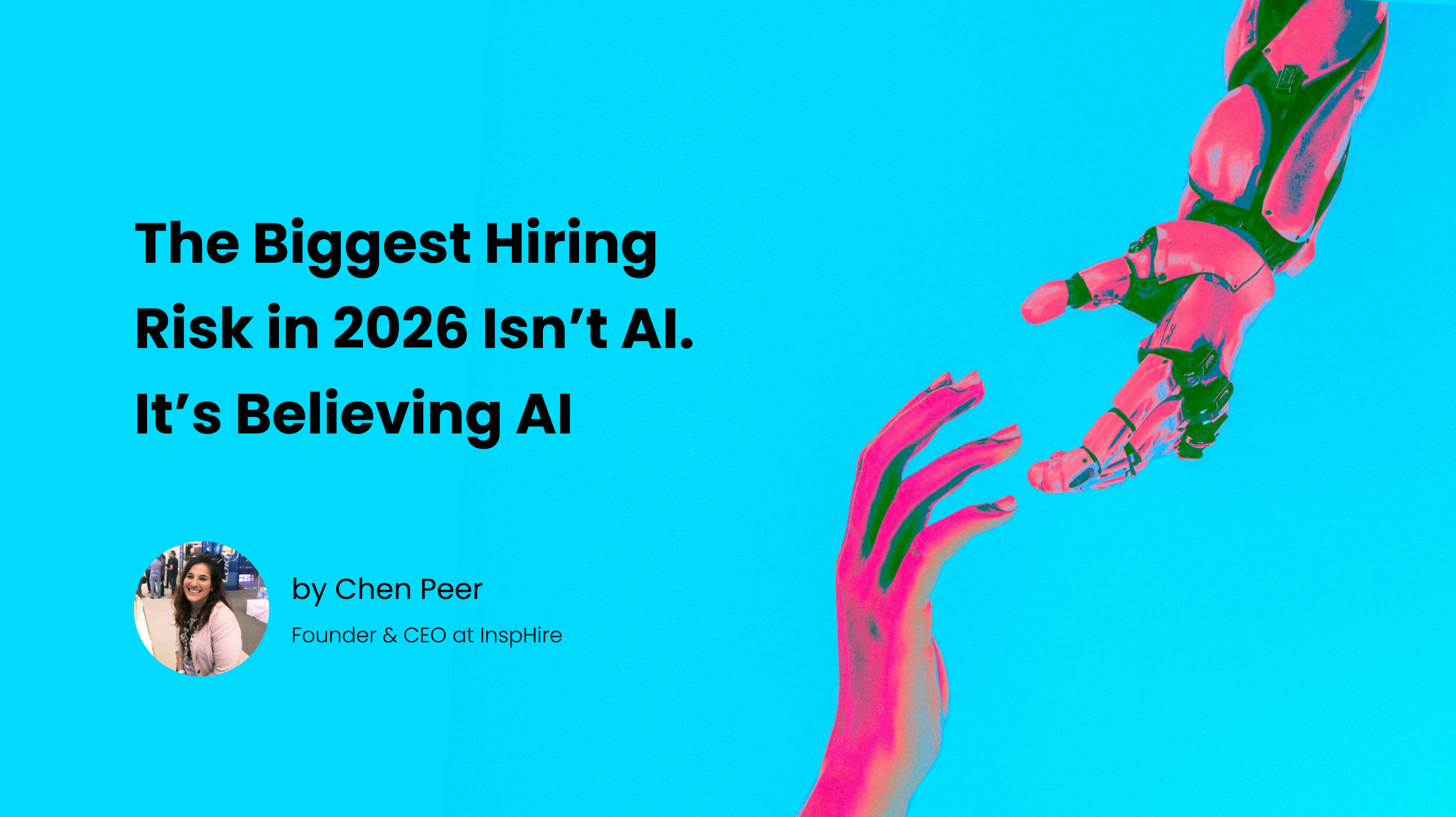
The biggest risk today is not that candidates use AI. It’s that companies believe the output reflects reality.
The companies that will hire successfully in the next few years won’t necessarily be the ones using more AI. They’ll be the ones who understand where AI stops being reliable, and how to design hiring processes around that reality.
by Chen Peer, CEO & Founder at InspHire, a recruitment consultancy specializing in recruiting talent in the Internet industry in Israel and abroad

InspHire is a 360° HR company taking a unique approach of specializing in building and improving HR processes and recruiting for global internet companies. Our approach and industry experience equipped us with deep knowledge and understanding in the world you work in. We cover every aspect of HR services that your company needs, from direct hire placements to trainings, employer branding, and welfare programs.